SOC 2 Readiness Assessment: Find Out Where Your SaaS
Company Actually Stands

A prospect asked for your SOC 2 report. An investor wants proof of your security posture. A customer’s legal team is reviewing your controls. Answer 12 questions and get an instant scored result showing exactly where you stand - and what it means for a real audit.

Built from actual SOC 2 assessment experience, not a vendor checklist.

Trusted By
LexisNexis logocortavoAventis SystemsAcornstenovoselligint healthapplied intuitionmyfitnesspalcelpointdigitaltaxbitcoastInterDevInvita
LexisNexis logoIgloo logoRoadie logoAvertium logoEphicient logoPangeo logomasterb2b logovergent logo
imageimage
Our Approachimage
image

SOC 2 Isn’t a Compliance Box. It’s a Growth Lever — or a Roadblock.

  • For SaaS companies selling to mid-market and enterprise buyers, SOC 2 has become a prerequisite - not a differentiator. Deals stall. Questionnaires pile up. Security reviews drag on. The companies that close faster are the ones that can prove their security posture before procurement even asks.
    • Enterprise buyers require SOC 2 before contracts are signed — often before a demo even gets scheduled
    • Investors are asking for it earlier in diligence, especially at Series A and beyond
    • Security questionnaires are getting longer and harder to answer without documentation to back them up
    • Most SaaS companies underestimate how long the readiness process actually takes — typically 6–12 months for a first audit
See Where you stand

You'll Know Exactly Where You Stand

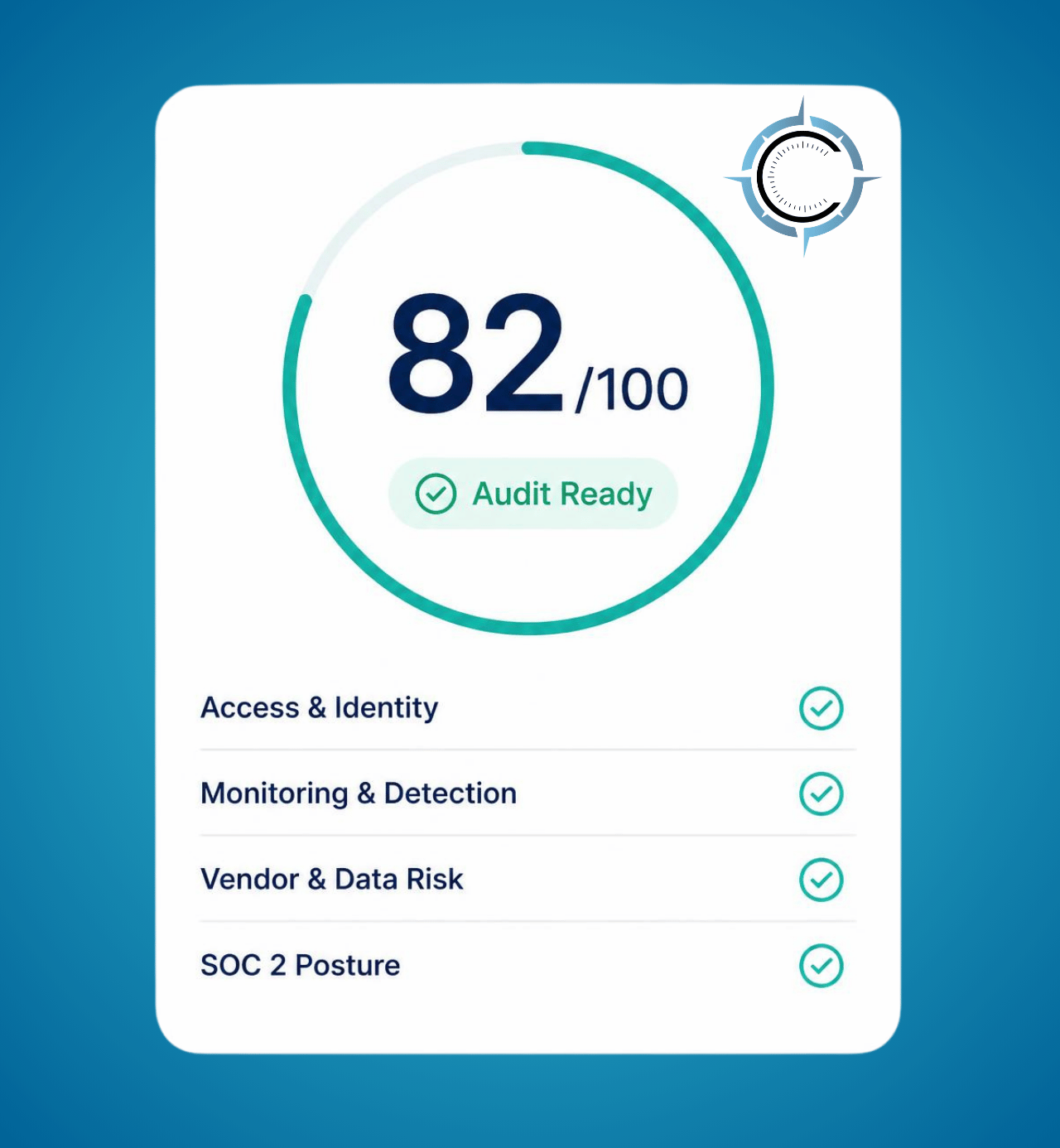
Not a vague score. Not a generic recommendation. The assessment scores you out of 100 across four readiness tiers — weighted the same way an auditor weights these controls in a real engagement. Here's what each result means:

The Same Categories a Real SOC 2 Auditor Looks At

Access & Identity

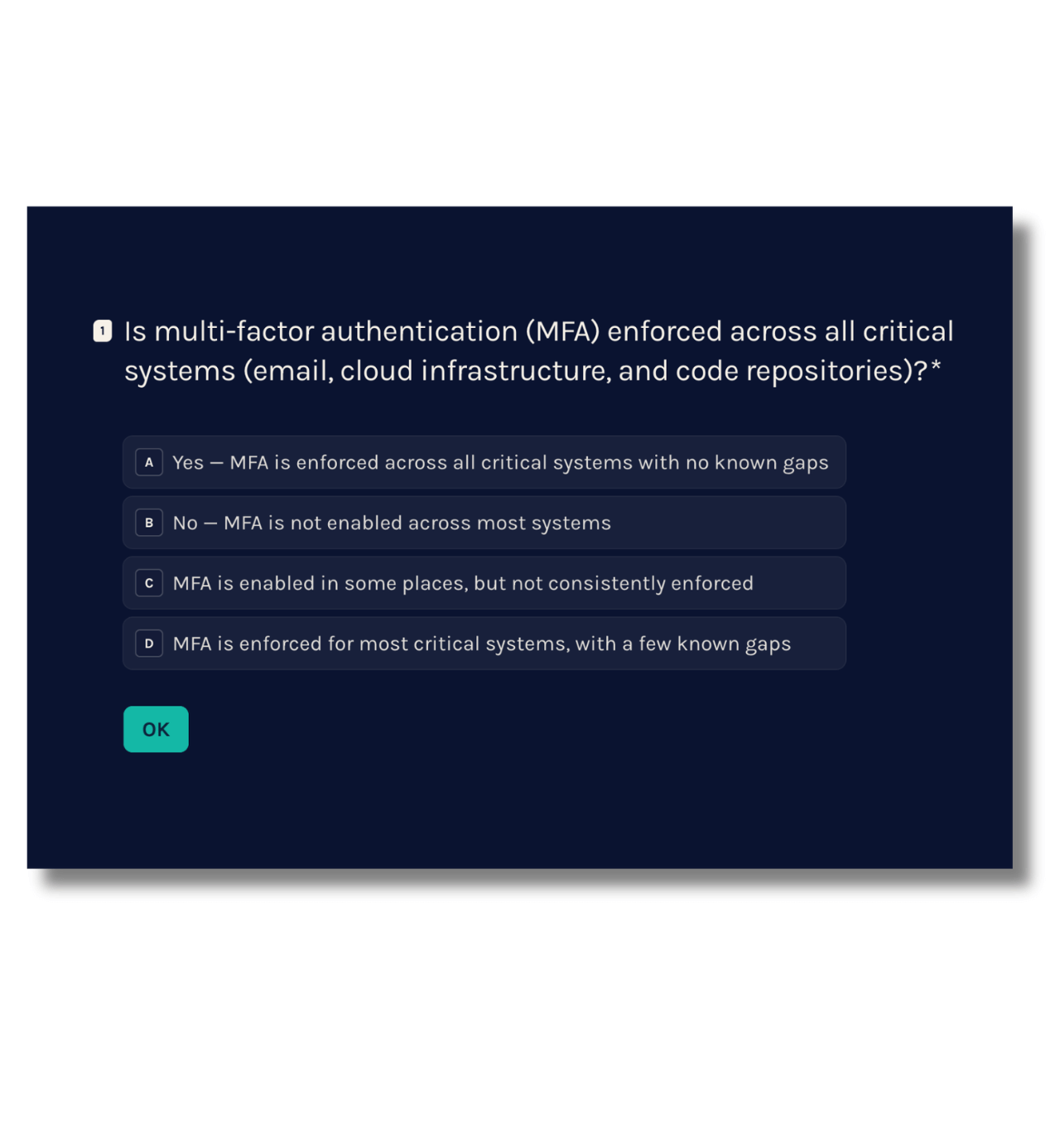
Are the right people in, and are the wrong people out? MFA enforcement across all critical systems. Offboarding speed and coverage. Role-based access control with least privilege and regular reviews.

Monitoring & Detection

Would you know if something went wrong? Logging, alerting, incident response planning, and how fast your team would detect a compromised account.

Vendor & Data Risk

Do you know what your tools and vendors can access? Vendor tracking, data mapping, and documented handling rules for sensitive information.

SOC 2 Posture & Maturity

Are your controls a one-time project or an ongoing process? Control consistency, security ownership, and your ability to respond when a customer asks about your security today.

Our Approachimage
image

How it Works:

Step 1 — Answer 12 Questions
Multiple choice. Each question maps to a real SOC 2 control and is weighted by how heavily auditors scrutinize it.

No jargon, just honest questions about how your team actually operates today.

Step 2 — Get Your Scored Result
Your answers generate a score out of 100, mapped to one of four readiness tiers. You’ll get a plain-language interpretation of what your result means - specific to where you are, not a generic next step.

Step 3 — Book a Free Call (Optional)
Every result includes the option to book a free 30-minute call with Ramin. If you want to go deeper, a specific remediation plan, full audit preparation, or an ongoing readiness engagement - that’s where it starts.

Start The Assessment
Our Approachimage
image
Our Approachimage
image

Built From Real Assessment Experience

  • There’s no shortage of SOC 2 checklists on the internet. Most are generated by software vendors who want to sell you a compliance platform. This is different.
  • TechCompass works with SaaS companies as a consulting partner — sitting in the room with founders, engineers, and auditors through the actual readiness process. This assessment is built from the same four control categories evaluated in those engagements, weighted the way a real audit weights them.
  • It won’t replace a full readiness engagement. But it will give you an accurate baseline - the kind that tells you whether you need one.
Why This Mattersimage
Methodologyimage
image

IT & Security Tooling Optimization Assessment

  • Do you have a complete inventory of all security and IT tools in your environment?
  • Have you evaluated tool overlap and redundancy within the past year?
  • Are your security tools properly integrated to maximize effectiveness?
  • Do you have an automation strategy to reduce manual efforts?
  • Are all tools being used to their full capability?
  • Have you reviewed your security tool licensing and usage costs recently?
  • Is your IT team adequately trained to manage and optimize all deployed tools?
  • Have you mapped your security tools to business needs and risk priorities?
  • Do you have a process for regularly assessing and retiring underperforming tools?
  • Have you discussed cost-saving opportunities with your vendors or MSP?

Scoring:

  • 8-10 Yes: Your toolset is well-optimized with minimal inefficiencies.
  • 4-7 Yes: Some improvements can be made to consolidate and better utilize tools.
  • 0-3 Yes: Your organization likely has significant inefficiencies—consider a tool audit and optimization plan.
Take the Assessment
How We Helpimage
image

Cyber Insurance Readiness Assessment

  • Do you have a documented cybersecurity policy that aligns with industry best practices?
  • Is multi-factor authentication (MFA) enabled across all critical systems?
  • Do you have an incident response plan that includes cyber insurance claim procedures?
  • Are your data backups encrypted, offsite, and regularly tested?
  • Do you perform employee cybersecurity training at least annually?
  • Have you conducted a risk assessment in the past 12 months?
  • Are your systems monitored 24/7 for security threats?
  • Do you use endpoint detection and response (EDR) solutions?
  • Have you reviewed your cyber insurance policy exclusions and coverage limits?
  • Are you meeting all insurer security requirements to avoid higher premiums?

Scoring:

  • 8-10 Yes: You have strong security controls and should qualify for lower premiums.
  • 4-7 Yes: Some improvements are needed to optimize your insurance costs.
  • 0-3 Yes: You are at high risk—act now to improve security and reduce costs.
Our Approachimage
image

Cyber Insurance Premium Reduction Assessment

  • Have you implemented multi-factor authentication (MFA) across all accounts?
  • Do you have a zero-trust security model in place?
  • Are you using next-generation firewalls and intrusion detection systems?
  • Have you established a documented vulnerability management program?
  • Are your privileged accounts secured using Privileged Access Management (PAM) solutions?
  • Do you enforce role-based access controls (RBAC) and least privilege principles?
  • Are your endpoint devices protected with advanced EDR solutions?
  • Have you engaged in cybersecurity awareness training for all employees?
  • Do you conduct regular penetration testing and vulnerability scans?
  • Have you shared your security improvements with your insurance provider to negotiate lower premiums?

Scoring:

  • 8-10 Yes: You are maximizing security and should negotiate the lowest possible premiums.
  • 4-7 Yes: Improvements can be made to further reduce costs—consider implementing additional controls.
  • 0-3 Yes: Your security posture is increasing your insurance costs—act now to enhance protections and negotiate better rates.
Why This Mattersimage
image

Five Minutes Now Saves Six Months of Guessing

The earlier you know where your gaps are, the more time you have to close them before an auditor, or a prospect - finds them first.

The assessment is free, takes about 5 minutes, and gives you a specific, scored picture of where your company stands today.

Frequently Asked Questions

What is a SOC 2 readiness assessment?

A SOC 2 readiness assessment evaluates whether your current security controls would hold up under a real SOC 2 audit, scoring you across the same categories an actual auditor reviews — access and identity, monitoring and detection, vendor and data risk, and overall control maturity.

How long does the SOC 2 readiness assessment take?

The assessment itself takes about 2 minutes to complete. A first SOC 2 audit typically takes 6–12 months from start to certification, depending on your starting point.

Is the SOC 2 readiness assessment free?

Yes. The assessment and scored result are free. Every result includes the option to book a free 30-minute call with Ramin to go deeper.

What happens after I get my score?

You'll get a plain-language interpretation of your result — specific to your tier, not a generic next step. If you want to go deeper, a specific remediation plan, full audit preparation, or an ongoing readiness engagement is where that conversation starts.

Score Your Result What It Means
76–100 Audit Ready Your controls are in solid shape. What separates good from great at this point is continuous monitoring, keeping controls from drifting between audits, and staying ahead of the next level of investor and customer scrutiny. The certification is the beginning, not the finish line.
51–75 Getting Close You're doing a lot of things right. Your fundamentals are in place and you're not far from audit-ready. The gaps at this score are typically in continuous monitoring, vendor risk, and the ability to prove controls are working — not just that they exist. Those are solvable in 60–90 days with the right focus.
26–50 Building the Foundation You've got the right instincts and you've started building — but there are gaps that will surface in a real audit or a customer security questionnaire. The priority at this stage isn't adding new tools. It's making sure what you have is actually working and provable.
0–25 Not Ready Your score suggests real gaps in the foundational controls that SOC 2 auditors and enterprise buyers look for. That's not unusual at your stage — and it's fixable. Most of what matters here costs very little to put in place. The first step is knowing where to focus.